
Boise sits in a high desert climate that swings between genuine extremes over the course of a year, and sometimes within a single day. Summer afternoons regularly push past ninety five degrees, while winter nights can drop well below freezing, and the Treasure Valley often sees dramatic temperature shifts between morning and afternoon even during the shoulder seasons. This kind of range is genuinely tough on a vehicle, since so many components are calibrated to work best within a fairly narrow temperature window, and Boise routinely asks them to perform across a much wider one.
Why Temperature Swings Matter More Than Extremes Alone
A vehicle built to handle either consistent heat or consistent cold can often be engineered with that specific condition in mind. Boise’s challenge is different, since the same vehicle has to handle both extremes well, sometimes within the same week during a fall cold snap that follows an unusually warm October afternoon, or a spring day that starts near freezing and climbs into the seventies by mid afternoon. This constant back and forth puts more cumulative stress on certain components than a steady climate at either extreme would, since materials are repeatedly expanding and contracting rather than settling into one consistent state.
How Tires Respond To Boise’s Temperature Range
Tire pressure is directly affected by temperature, dropping roughly one pound per square inch for every ten degree decrease in ambient temperature. In a climate with Boise’s range, this means a tire properly inflated on a warm September afternoon can be noticeably underinflated by the time a cold snap arrives in November, even without any physical damage or slow leak involved. Underinflated tires wear unevenly, reduce fuel efficiency, and increase the risk of a blowout, particularly at highway speeds on routes like I 84 or I 184.
The reverse effect matters too. A tire properly inflated during a cold winter morning can become slightly overinflated once temperatures climb significantly during the day, which is a smaller concern but still worth factoring in if you are checking pressure only once and assuming it will hold steady through Boise’s often dramatic daily temperature shifts.
Why Batteries Struggle With Constant Swings
Extreme heat accelerates the internal chemical breakdown that shortens a battery’s usable life, while extreme cold reduces the battery’s ability to deliver the power needed for starting. Boise batteries essentially face both challenges throughout the year, wearing down faster during summer heat and then being asked to perform at their weakest exact moment during a winter cold snap. This combination means Boise area batteries often show a shorter effective lifespan than the same battery might achieve in a more temperature stable climate, even if the total number of extreme days is not especially high compared to more consistently harsh climates elsewhere.
A battery that seemed to perform fine through a mild fall can reveal accumulated summer heat damage the moment a genuine cold snap arrives, since the reduced cranking power that comes with cold temperatures exposes weaknesses that were not obvious during milder weather. If you have experienced a starting failure that seemed to come out of nowhere, our guide on the top 10 reasons your car won’t start and how to get back on the road covers a range of causes, several of which are more likely to surface after a battery has already been weakened by a hot Boise summer.
Fluids That Deserve Extra Attention In This Climate
Engine oil viscosity is designed to perform within a certain temperature range, and Boise’s swings mean the same oil grade needs to handle both summer heat and winter cold reasonably well throughout a typical ownership period. Using the manufacturer recommended oil weight, rather than defaulting to whatever was convenient at the last change, matters more here than it would in a climate with a narrower annual temperature range, since the margin for error shrinks when the oil has to perform well across such a wide spread.
Coolant concentration also deserves attention given Boise’s range. A coolant mixture that is not properly balanced can offer inadequate protection against freezing during a hard winter cold snap, while also potentially reducing cooling efficiency during the intense heat of a Treasure Valley summer. Checking your coolant’s freeze protection rating before winter and confirming the mixture is appropriate for both ends of Boise’s temperature spectrum is a simple step that pays off in both directions.
Signs Your Vehicle Is Struggling With The Swings
A few signs suggest your vehicle could use some attention given Boise’s temperature range. Noticeably lower tire pressure warnings that seem to coincide with cooling weather, a battery that cranks more slowly than it used to, especially after a hot summer, or coolant that appears low or discolored are all worth checking. Fluctuating engine temperature readings that seem tied to outside air temperature rather than driving conditions can also indicate a cooling system that is not handling the seasonal transition as well as it should.
Windshield wipers and rubber seals are worth a quick mention here too, since these components are especially sensitive to repeated expansion and contraction as temperatures swing. A wiper blade that performed fine during a mild stretch of weather can develop cracks or lose contact with the glass once it has been through a few cycles of Boise’s characteristic hot to cold transitions, leaving you with reduced visibility exactly when a sudden fall or spring rain shower catches you off guard.
Why A Mobile Mechanic Fits Boise’s Climate Reality
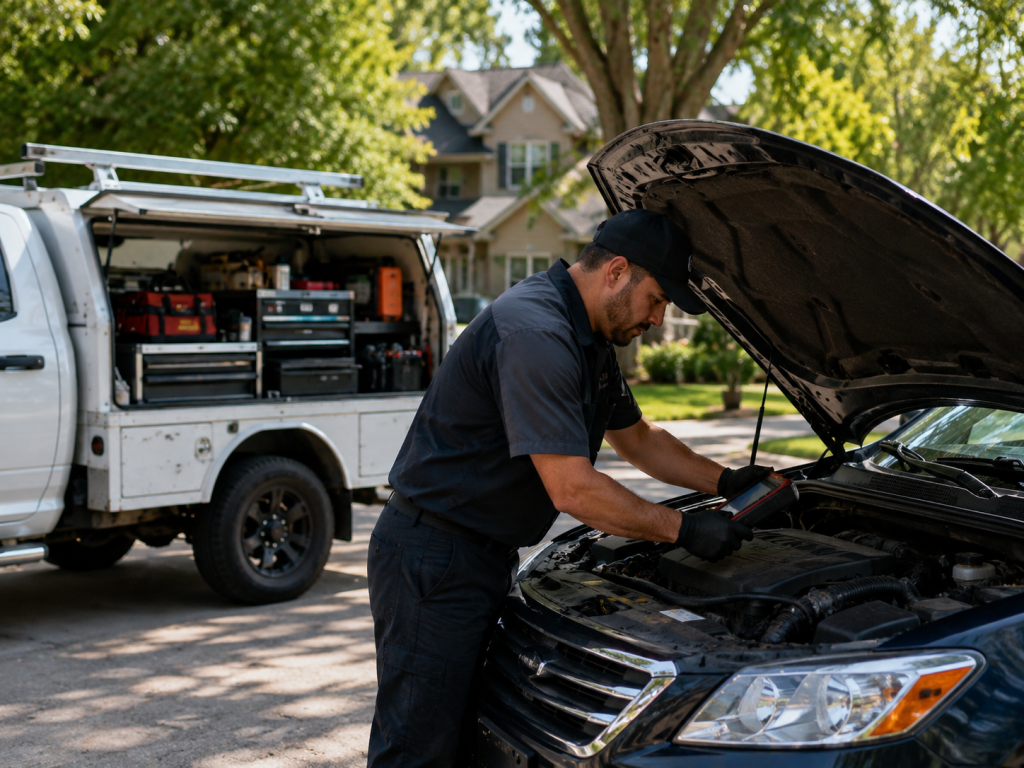
Given how much of this maintenance revolves around checking multiple systems as the seasons shift, having a technician come to your home or workplace anywhere in the Treasure Valley makes it easier to stay ahead of these temperature driven changes rather than waiting for a scheduled shop appointment that may not align with an upcoming cold snap or heat wave. A mobile mechanic can check tire pressure, battery health, and fluid condition together in one visit, timed around the seasonal transitions that matter most for your specific vehicle.
We covered the broader benefits of this approach in our article on why mobile mechanics are better than traditional auto shops in Boise, which explains how convenience and flexible scheduling come together, particularly useful for staying ahead of a climate that changes as quickly as ours does.
Stay Ahead Of Boise’s Wide Temperature Range
Idaho’s high desert climate is part of what makes living here appealing, with genuine seasons and plenty of sunshine throughout the year, but that same range asks a lot of your vehicle’s tires, battery, and fluids. Checking these systems more deliberately around seasonal transitions, rather than only once or twice a year on a fixed calendar, is one of the simplest ways to avoid being caught off guard by a temperature driven failure. Timing a checkup to land right before the first hard freeze of the year, or right as summer heat starts to build, tends to catch far more developing issues than a checkup scheduled at a random point in the middle of a mild stretch of weather.
If it has been a while since your vehicle had a proper seasonal checkup, reach out through our contact us page to schedule a visit at your home or office anywhere in the Boise area.
A little attention timed around Boise’s temperature swings can help your car handle everything the Treasure Valley’s climate throws at it throughout the year.